

If you need glasses, your eye doctor will provide you with a prescription for corrective lenses. Eyeglass prescriptions may be written in different ways, though most are either printed or handwritten in horizontal rows. The first row is the prescription for the right eye (OD), and the second row is for the left eye (OS). Within each of these rows are three values: Sphere (SPH), Cylinder (CYL), and Axis. The SPH number corrects for nearsighted [indicated with a minus (-)] or farsighted [indicated with a plus (+)] vision. The CYL number and AXIS number correct for astigmatism. You may also have another field labeled as ADD which corrects for the reading power used in a bifocal or progressive lens. To learn more about how to read your prescription, click here. Lastly, eyeglass prescriptions sometimes include the pupillary distance (PD) measurement, which is the distance between your pupils. PD is needed to determine where the optical center of the lens will be for clear, accurate vision. If your prescription does not include your PD, you can measure it yourself with our guide here. An eyeglass prescription will usually expire in 1-2 years, depending on which state you received your eye exam.
🧾 Eyeglass Prescription Summary Table
| Field | Full Name | Purpose | Typical Format | Notes |
|---|---|---|---|---|
| OD | Oculus Dexter | Refers to the right eye | First row | Latin abbreviation |
| OS | Oculus Sinister | Refers to the left eye | Second row | Latin abbreviation |
| SPH | Sphere | Corrects nearsighted (-) or farsighted (+) vision | e.g. -2.50 / +1.75 | Always includes + or – symbol |
| CYL | Cylinder | Corrects astigmatism | e.g. -0.75 / +1.25 | Optional – may be blank if no astigmatism |
| AXIS | Axis | Indicates astigmatism angle (0°–180°) | e.g. 90° / 175° | Only present if CYL is given |
| ADD | Addition | Adds reading power for bifocal/progressive lenses | e.g. +2.00 | Typically the same for both eyes |
| PD | Pupillary Distance | Distance between pupils (center to center) | e.g. 63mm (or 31.5/31.5) | May be single (total) or dual (per eye); often required for lens fitting |
| Expiry | Prescription Validity | Indicates how long the prescription remains valid | 1–2 years | Depends on local regulations |
📎 Tips:
If your PD is not on the prescription, you can measure it yourself.
Some prescriptions may include additional notes like prism correction or base direction.
Here is a list of some optical abbreviations that will help you order your glasses from Zenni Optical:
ADD (also NV-ADD): the Near Vision (NV) Reading ADDition correction on a multifocal Rx. Can be used for bifocal or progressive glasses, or for single-vision reading or computer (intermediate) vision glasses.

AR: Anti-Reflective. A coating that reduces reflection on the lenses.
AXIS: the angle at which the Cylinder (CYL) is placed on a lens to correct an astigmatism. It ranges from 1 to 180.
BAL: the Rx calls for balance lenses, meaning the same Rx for each eye. Often used when a person has no sight in one eye, so both lenses will have the same thickness.
BD, BI, BO, BU: a prism correction on your Rx (may be indicated with Δ, and one of these four abbreviations. The B stands for base, and it could be base down (BD), base in (BI), base out (BO), or base up (BU).
CYL: the Cylinder. Combined with the AXIS, the CYL corrects an astigmatism.
DS: the abbreviation for diopter simplex. An eye dr. may write DS on an Rx in the Cylinder (CYL) field if no astigmatism correction is needed.
DV: distance vision.
FT: flat-top bifocal.
NV: near vision.
NV-ADD (also ADD): the Near Vision (NV) Reading ADDition correction on a multifocal Rx. Can be used for bifocal or progressive glasses, or for single-vision reading or computer (intermediate) vision glasses.
OD: Latin for Oculus Dexter, meaning the right eye.
OS: Latin for Oculus Sinister, meaning the left eye.
OU: Latin for Oculus Uterque, meaning each eye.
PAL: Progressive Addition (or Adjustment) Lens: sometimes on a Progressive Rx an eye dr. will write two different numbers for the NV-ADD, perhaps +2.25 and +2.50, to increase the reading power in the NV-ADD for Progressive lenses.
PD (Pupillary Distance): the PD is the measurement of the distance between your pupils. This is needed for the manufacturer of the eyeglasses to know where to place the optical center on each lens, so you can see well with the glasses.
PL: Plano. Latin for “flat.” If this is in the SPH section of an Rx, it means no nearsighted or farsighted correction is needed.
RX: a prescription.
SPH: the first section on an Rx. It corrects nearsighted or farsighted vision.
UV: the abbreviation of ultraviolet. UV light is invisible to the human eye, but it is UV light that gives us a sunburn, and too much exposure to it can damage the eye. All of the lenses Zenni Optical offers come with 100 percent UV protection, for free.
VA: Visual acuity: how well the eye can see. Sometimes this may be written on an Rx, with a number such as 20/20. This would indicate that with eyeglasses made to this Rx, the vision would be corrected to 20/20 vision.
Your pupillary distance (PD) is the measurement of the distance between your pupils. Click here to learn more.
You bet we can!
Single-vision Rx:
Up to -20.00 or +12.00 on the Sphere (SPH
Up to + or – 6.00 on the Cylinder (CYL).
Bifocal Rx:
Up to -9.00 or +6.00 on the SPH.
Up to + or – 6.00 on the CYL.
Up to +3.50 on the NV-ADD.
Progressive Rx:
Up to -10.00 or +8.00 on the SPH.
Up to + or – 6.00 on the CYL.
Up to +3.50 on the NV-ADD.
Prism (single-vision only):
Up to 5.00 in any base direction.
Most people have an astigmatism. If you have an astigmatism on your Rx, we can make glasses that will correct it.
Yes! We offer both. If you have ADD or NV-ADD on your Rx, you can get lined bifocals or unlined progressive glasses.
Contact us to send details.
Contact us to send details.
Contact us to send details.
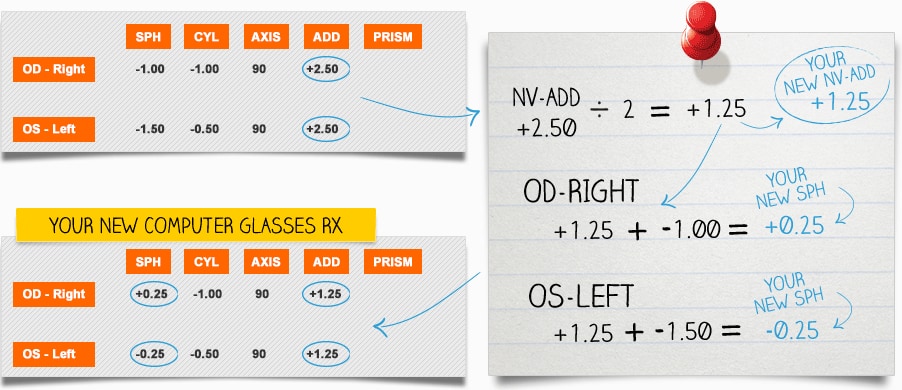
You bet you can! Divide the NV-ADD in half. Add one of the halves to your SPHs. Leave the other half in the NV-ADD. This creates computer vision in the top of your lens, and reading vision in the bottom!
Yes, we can fill prescriptions with prism correction in single-vision lenses only. You will enter in the values for each eye in Step 1 of the order process according to the script given by your doctor. After you fill in Sphere (SPH), Cylinder (CYL), and Axis numbers for each eye, you will click “Yes” under Prism Values. You will then select your Prism Horizontal (for Base In/Base Out) and Prism Vertical (for Base Up/Base Down) values in diopters and indicate the direction for each value on your prescription for each eye.
To learn more about prism corrections, click here.
Sorry, a contact lens Rx can only be used for contact lenses.
Contact us to send details.
We strongly recommend that you get an eye exam every two years, or more frequently if you notice that your vision has changed.
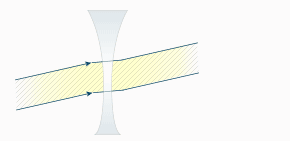
The Lens Index number (1.50, 1.57, 1.53, 1.59, 1.61, 1.67, or 1.74) refers to the degree of refraction the lens provides. This means how much the light that enters the lens is refracted (bent) as it passes through the lens. Lens Index is also related to the thickness of the lens. The higher the index, the thinner the lens will be. Learn more here about what index is best suited for your Rx, lifestyle, and frame selection.
The lens that is preselected as a recommended option in ② Your Lenses during the ordering process will be the best option for your Rx. If you have a strong Rx, a higher lens index number will give you a thinner lens.
We offer aspheric lenses for our standard 1.67 high index lens, Blokz 1.67 high index lenses, Blokz tinted 1.61 high index lens, Blokz tinted 1.67 high index lens, Blokz photochromic 1.61 high index lens, and Blokz photochromic 1.67 high index lens.
Aspheric lenses are provided for the lenses listed above in this range: Sph 0 to -10.00, Cyl -2.00 to +2.00
The aspheric lens surface improves visual quality and reduces distortion of the wearer’s eyes as seen by others.
All Optical eyeglasses come with Anti-Scratch Coating and UV Protection Coating that are both absolutely free. We also offer Anti-Reflective (also known as Anti-Glare) Coatings, which reduce reflection on the lenses and the glare you see while you are wearing your glasses.
Our anti-reflective coating options include: standard, water-resistant, oil-resistant, and anti-fog.
Anti-reflective coating is applied to both sides of the lenses for most glasses and on the backside of the lenses for premium sunglasses.
Glasses fog up when you move from hot to cold environments, wear a mask or helmet, engage in outdoor activities or chores such as cooking.
Anyone who experiences foggy lenses can benefit from adding anti-fog coating to their glasses order.
Anti-fog + anti-reflective coating reduces glare and helps prevent your lenses from fogging up. The anti-fog coating is on both sides of the lenses for most glasses and on the backside of the lenses for premium sunglasses. Each pair of anti-fog coated lenses comes with a special anti-fog activator lens cloth that activates the anti-fog properties every time you clean your lenses to help keep them extra clear.
Photochromic lenses are specially treated to turn dark when exposed to UV light. When the lenses are out of the sunlight, they become clear again. We carry f photochromic lenses for our 1.50, 1.61, and 1.67 lenses, for both single-vision and progressive glasses.
A Polarized lens is a sunglass lens that greatly reduces the glare from light that is Polarized horizontally, meaning the light reflecting off horizontal surfaces, such as a white sidewalk, a white-sand beach, snow, or sunlight reflecting on water.

Polycarbonate lenses are impact resistant, and are stronger and more lightweight than standard lenses, which makes them a great option for kids’, rimless, and sports glasses, or for anyone who is rough on their glasses.
Do you want a tint to make your glasses into dark sunglasses?
– We offer 3 sunglass tints: Dark Gray, Dark Amber, and Dark Green.
– We offer 8 gradient tints: Smoke Gray, Golden Amber, Dusk Blue, Sage, Desert Rose, Ultraviolet, Neon Pink and Electric Blue.
Do you want a tint that is darker at the top, and gradually gets lighter towards the bottom?
– We offer gradient tints: Smoke Gray, Golden Amber, Dusk Blue, Sage, Desert Rose, Ultraviolet, Neon Pink and Electric Blue.
Do you want a tint that is lighter, or more colorful to enhance the appearance of your everyday glasses?
– We offer fashion tints in Gray, Amber, Green, Blue, Fuchsia, Lavender, Orange, Rose, Yellow and Red.
After selecting your frame and lens material you can add your favorite tint from 3 categories listed above – Sunglass, Gradient or Fashion Tints.
Our sunglasses tints – dark amber, dark grey, and dark green are 80% darkness. Our gradient tints start with 70%-80% darkness on the top of the lens with an even gradation to 10% darkness at the bottom of the lens. Our fashion tints come in various levels of 10-50% darkness.
Polarized lenses are known for cutting out glare and light intensity which is very noticeable when light reflects off of water, snow, and sand. Dark lens tints are known for only cutting down the intensity of light. Some instance where dark tints are beneficial over polarized lenses is if you are using a digital screen outdoors. This is because polarized lenses will darken your view of the screen. Polarized lenses are known to improve visibility with driving, especially in severe weather conditions, therefore making you a safer driver.
Mirrored lenses are created with a highly reflective coating that reduces glare by reflecting light away. These sunglass lenses are highly functional yet also fashionable.
We offers 8 different mirror colors: Silver, Gold, Rose Gold, Flame Red, Lavender, Indigo Blue, Sky Blue, and Moss Green.
We offer night driving clip-ons that can easily be made for any frame except our magnetic frames. Our night driving clip-ons enhance contrast, and reduce glare from oncoming car headlights while driving at night. These clip-on lenses have a yellow color, and the included double-sided anti-reflective coating is designed to minimize glare from surrounding light.
Note: The clip-ons are cut slightly larger than the optical lenses to provide full coverage.
Our Face Shape Guide features tools to help you discover what your face shape is, as well as frames by face shape for men and women.
It depends on what features you are looking for. The following categories can help with your decision:
Weight: If you want a super light frame, go with one that’s 15 grams or lower. Titanium frames are generally very light.
Material: You have the choice between metal or plastic. Metal tends to be lighter. Plastic frames tend to be more durable.
Flexibility: This is a nice feature to have for kids or sports glasses. We have a line of kids plastic flexible frames that are forgiving and durable.
Color: Plastic frames tend to come in more color options, especially acetate plastic.
Hypoallergenic: Stainless steel, titanium, and acetate frames are hypoallergenic.
Most of our frames come in one size, but not all. The details will be listed under the product description. Please use the size filter to find the one that best suits you.
Yes, we offer a great selection of universal bridge fit also known as low bridge fit or Asian fit frames.
Some frames have a series of numbers printed on the inside of a temple arm (the part that goes behind your ear). The first numbers are typically the manufacturer’s style number and a color code. But farther down the temple arm, there may be important numbers that refer to the dimensions of the frame. These numbers are the measurement, in millimeters, of the lens width, nose bridge width, and temple arm length. Often the lens width and nose bridge width are 2-digit numbers separated by a square, and a temple arm length is a 3-digit number in front of or behind the others. Knowing these numbers can help you choose a frame similar in size when shopping.

our Rx may be too strong for half-rim or rimless glasses, so full-rim would be your option. Full-rim glasses, especially in the nerd-chic look, are very popular. They are generally more durable than half-rim or rimless frames. Half-rim frames are great for people with slim faces. They show more of your face than full-rim frames, and are more durable than rimless glasses. Rimless glasses are great for people who will treat their glasses delicately, and who want their glasses to be practically invisible on their face.
Most of our frames come in multiple colorways. If a frame comes in more than one color, you will see the options on the frame’s product description page.
Yes. When a frame is out of stock, you will see an “out of stock” message below the frame. Enter your email address in the space provided, and we’ll let you know when the item becomes available.
Most of frames can do. It depends on the frame whether text or icons can be engraved, as well as placement options (inside the temple arm or outside).
New glasses often need minor tweaks to fit your face right. It’s best to have an optician fine-tune the glasses for you, but you can also make adjustments yourself with our How to Adjust Your Glasses guide.
If you need glasses, your eye doctor will provide you with a prescription for corrective lenses. Eyeglass prescriptions may be written in different ways, though most are either printed or handwritten in horizontal rows. The first row is the prescription for the right eye (OD), and the second row is for the left eye (OS). Within each of these rows are three values: Sphere (SPH), Cylinder (CYL), and Axis. The SPH number corrects for nearsighted [indicated with a minus (-)] or farsighted [indicated with a plus (+)] vision. The CYL number and AXIS number correct for astigmatism. You may also have another field labeled as ADD which corrects for the reading power used in a bifocal or progressive lens. To learn more about how to read your prescription, click here. Lastly, eyeglass prescriptions sometimes include the pupillary distance (PD) measurement, which is the distance between your pupils. PD is needed to determine where the optical center of the lens will be for clear, accurate vision. If your prescription does not include your PD, you can measure it yourself with our guide here. An eyeglass prescription will usually expire in 1-2 years, depending on which state you received your eye exam.
Here is a list of some optical abbreviations that will help you order your glasses .
ADD (also NV-ADD): the Near Vision (NV) Reading ADDition correction on a multifocal Rx. Can be used for bifocal or progressive glasses, or for single-vision reading or computer (intermediate) vision glasses.
AR: Anti-Reflective. A coating that reduces reflection on the lenses.
AXIS: the angle at which the Cylinder (CYL) is placed on a lens to correct an astigmatism. It ranges from 1 to 180.
BAL: the Rx calls for balance lenses, meaning the same Rx for each eye. Often used when a person has no sight in one eye, so both lenses will have the same thickness.
BD, BI, BO, BU: a prism correction on your Rx (may be indicated with Δ, and one of these four abbreviations. The B stands for base, and it could be base down (BD), base in (BI), base out (BO), or base up (BU).
CYL: the Cylinder. Combined with the AXIS, the CYL corrects an astigmatism.
DS: the abbreviation for diopter simplex. An eye dr. may write DS on an Rx in the Cylinder (CYL) field if no astigmatism correction is needed.
DV: distance vision.
FT: flat-top bifocal.
NV: near vision.
NV-ADD (also ADD): the Near Vision (NV) Reading ADDition correction on a multifocal Rx. Can be used for bifocal or progressive glasses, or for single-vision reading or computer (intermediate) vision glasses.
OD: Latin for Oculus Dexter, meaning the right eye.
OS: Latin for Oculus Sinister, meaning the left eye.
OU: Latin for Oculus Uterque, meaning each eye.
PAL: Progressive Addition (or Adjustment) Lens: sometimes on a Progressive Rx an eye dr. will write two different numbers for the NV-ADD, perhaps +2.25 and +2.50, to increase the reading power in the NV-ADD for Progressive lenses.
PD (Pupillary Distance): the PD is the measurement of the distance between your pupils. This is needed for the manufacturer of the eyeglasses to know where to place the optical center on each lens, so you can see well with the glasses.
PL: Plano. Latin for “flat.” If this is in the SPH section of an Rx, it means no nearsighted or farsighted correction is needed.
RX: a prescription.
SPH: the first section on an Rx. It corrects nearsighted or farsighted vision.
UV: the abbreviation of ultraviolet. UV light is invisible to the human eye, but it is UV light that gives us a sunburn, and too much exposure to it can damage the eye. All of the lenses Zenni Optical offers come with 100 percent UV protection, for free.
VA: Visual acuity: how well the eye can see. Sometimes this may be written on an Rx, with a number such as 20/20. This would indicate that with eyeglasses made to this Rx, the vision would be corrected to 20/20 vision.
Your pupillary distance (PD) is the measurement of the distance between your pupils. Click here to learn more.
You bet we can!
Single-vision Rx:
Up to -20.00 or +12.00 on the Sphere (SPH
Up to + or – 6.00 on the Cylinder (CYL).
Bifocal Rx:
Up to -9.00 or +6.00 on the SPH.
Up to + or – 6.00 on the CYL.
Up to +3.50 on the NV-ADD.
Progressive Rx:
Up to -10.00 or +8.00 on the SPH.
Up to + or – 6.00 on the CYL.
Up to +3.50 on the NV-ADD.
Prism (single-vision only):
Up to 5.00 in any base direction.
Most people have an astigmatism. If you have an astigmatism on your Rx, we can make glasses that will correct it.
Yes! We offer both. If you have ADD or NV-ADD on your Rx, you can get lined bifocals or unlined progressive glasses.
Our high-definition premium progressives feature wider viewing areas for the intermediate and reading areas of the lens than standard progressives. Peripheral (side) distortion is reduced by up to 40% compared to the standard design. With premium progressives, the transition from distance viewing to looking at a computer, for example, to reading up close is more seamless, making adaptation easier and more comfortable.